Sponsored Products campaigns no longer run only on Amazon. Amazon's support article on off-Amazon advertising, updated on 12 October 2026, says campaigns can reach third-party sites, apps and creator content using the targeting, bids and budget already set, and that this is on by default. The detail that matters for Amazon PPC optimization is one line further down: the placement bid adjustments an agency has tuned for top of search do not apply off Amazon.
This guide covers what off-Amazon placements are, what they do to bids, budgets and the monthly report, how to decide whether to keep them, and how to prove every other kind of Sponsored Products, Brands and Display work.
Key takeaways
"Increase reach off-Amazon" is the default setting. "Limit reach to Amazon" turns it off per campaign.
Top of Search, Rest of Search and Product Pages bid adjustments do not apply off Amazon. The max bid and the budget do.
The Sponsored Products placement report is the only place Amazon shows off-Amazon results.
ACOS alone cannot tell a seller what to fix. Lead with total sales and what advertising cost to get them.
Sales keep arriving for 7 days (sellers' Sponsored Products) or 14 days (most other ad types) after a click.
What are Sponsored Products off-Amazon placements?
Off-Amazon placements are ad slots outside the Amazon store where a Sponsored Products ad can appear, with the click going to the product detail page. Amazon's off-Amazon advertising article lists three routes:
Third-party sites and apps: Amazon matches the ad to a placement and submits it to the publisher, which decides which ads appear and where.
Third-party sites and apps with Amazon investment: Amazon may pick the product on factors like price competitiveness and reviews, and add its own marketing funds.
Creator content: creators in the Amazon Influencer and Associates Program can choose to feature the campaign in reviews, editorial content and buying guides.
Amazon lists 19 countries, including the United States, United Kingdom, Canada, India, Germany and France. No new campaign is needed: existing Sponsored Products campaigns qualify on their current settings.
Do placement bid adjustments apply to off-Amazon clicks?
No. Amazon says bid adjustments for Top of Search, Rest of Search and Product Pages do not apply to off-Amazon placements, while dynamic bidding and rule-based bidding still do. What does carry over:
The maximum bid applies to every click, on or off Amazon, and the cost per click never exceeds it.
Every click counts toward the same campaign budget, and total spend never exceeds that budget.
The price is set differently by route. On publisher sites Amazon adjusts the bid using predicted click-through and conversion rates. For creator content it uses the max bid, expected performance and the sales the ad generates, and charges only when a shopper reaches a detail page or adds to cart.
So a campaign that relies on a 50% top-of-search adjustment and a modest base bid does not carry that uplift off Amazon; there, the base bid, shaped by dynamic bidding and Amazon's own predictions, is the starting point. That is not a reason to panic, but it does mean placement optimization now covers only part of the spend. A budget that used to run out at 4pm on Amazon traffic can now run out sooner, because off-Amazon clicks draw on it too.
Where do off-Amazon results show in Amazon reports?
Off-Amazon results show in the Sponsored Products placement report, and Amazon's placement report documentation says it is the only source for off Amazon store metrics for now. Through the API, the same split comes from the Placement Classification metric. Creator content that sends a shopper from off Amazon appears as "Off Amazon". When a shopper reaches the product from a creator's storefront on Amazon, it lands in an on-Amazon row Amazon calls "Other".
Everywhere else, campaign totals blend on- and off-Amazon traffic. A campaign whose ACOS moved last month may have changed nothing on Amazon at all. Before explaining a move to a client, split the placement report into its rows, now including Off Amazon, and see where the change sits. Our post on Amazon Ads unified reporting covers the console reporting move that is happening at the same time.
Should you limit Sponsored Products to Amazon?
Limit it only when the placement report shows off-Amazon clicks costing budget without the sales to match. The control sits in Campaign settings under Adjust reach on and off Amazon: "Increase reach off-Amazon" (the default) or "Limit reach to Amazon", changeable at any time and in bulk through bulksheets. A deny list can exclude specific sites, apps or creators instead of switching the whole channel off.
Amazon has not published typical results for off-Amazon placements, so this is a per-account decision. Compare the Off Amazon row's ACOS, sales and purchases with Rest of search over a closed period. For budget-limited campaigns, check whether time in budget fell after off-Amazon clicks started. For a launch or a brand with low awareness, extra discovery may be worth a higher ACOS. Like any Amazon PPC optimization call, write the decision down, with the numbers.
How do you prove each Amazon PPC optimization worked?
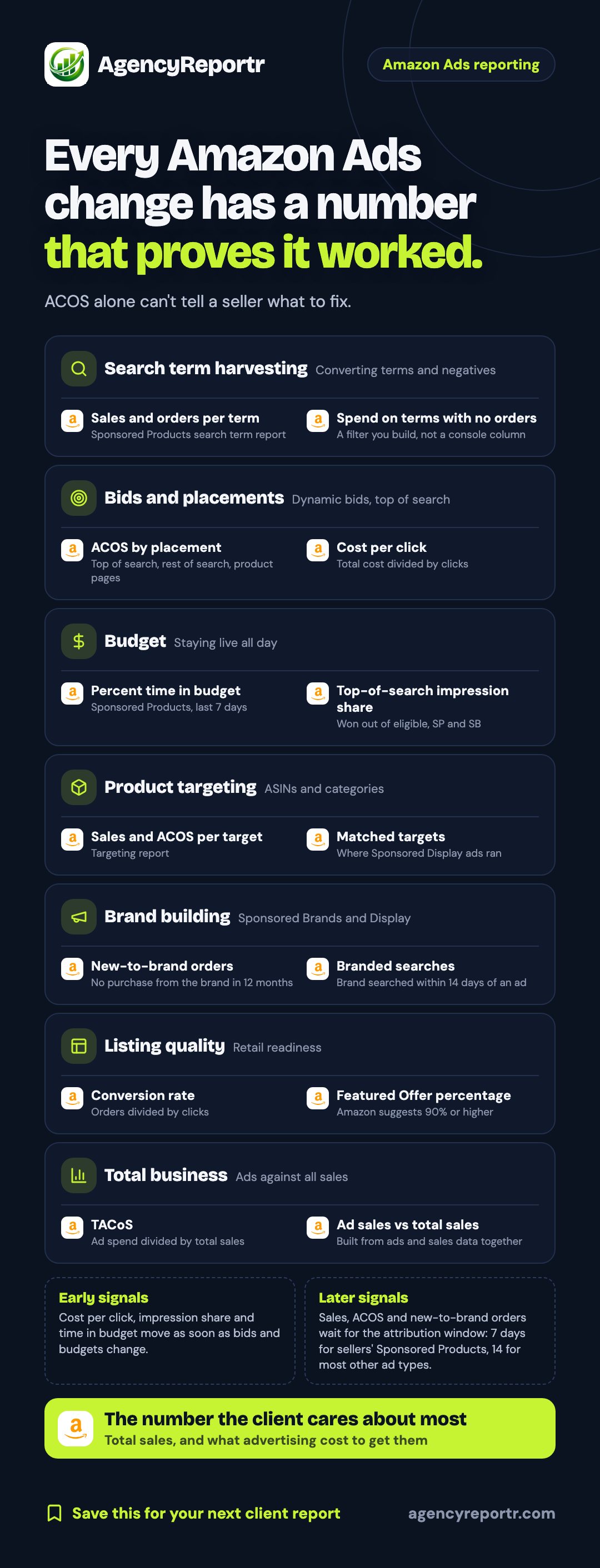
Prove each change with the Amazon number it was meant to move, shown before and after. Here is the full map: seven kinds of Amazon PPC work, two proof metrics each, and where Amazon reports them.
Save it for your next client report.
Work
The numbers that prove it
Search term harvesting and negatives
Sales and purchases per term from the Sponsored Products search term report, and spend on terms with no orders: a filter you build, not a console column.
Bids and placements
ACOS and sales by placement (top of search, rest of search, product pages and now Off Amazon), and cost per click: total cost divided by clicks.
Budget
Time in budget (the budget report's Average Time in Budget, with estimated missed sales), and top-of-search impression share for Sponsored Products and Sponsored Brands.
Product targeting
Sales and ACOS per target from the targeting report, and matched targets showing where Sponsored Display ads ran.
Brand building
New-to-brand purchases (no purchase from the brand in the previous 365 days) for Sponsored Brands and Display, and branded searches.
Listing quality
Conversion rate (orders divided by clicks) and featured offer percentage; Amazon suggests 90% or higher.
Total business
TACoS (ad spend divided by total sales) and ad sales against total sales, built from ads and selling data together.
Two notes. Top-of-search impression share has a 90-day lookback and can be delayed by up to 12 hours, so read it over weeks, not days. And listing work comes before ad work: Amazon's new advertiser guide recommends advertising products with five or more reviews and a rating of 3.5 stars or higher, and winning the featured offer ideally 90% of the time or more. Amazon has also renamed Orders to Purchases across sponsored ads reports, which is worth a line in the report so a client does not think a metric disappeared.
Why can't ACOS alone tell a seller what to fix?
ACOS is a ratio of spend to ad sales, so it can improve while the business shrinks. Amazon defines it as ad spend divided by ad revenue, times 100: spend $50 to earn $100 in ad sales and ACOS is 50%. ROAS is the inverse. ACOS can fall because you stopped advertising the products that were bringing in new customers, and it knows nothing about sales that came without an ad click.
That is why Amazon PPC optimization should be judged on total sales and what advertising cost to get them, with ACOS explaining efficiency underneath. Our explainers on what ACOS means and how TACoS is calculated cover the arithmetic. TACoS is not a console metric; it comes from combining ad spend with total sales from the selling account.
Amazon ad sales are final only once the attribution lookback window has closed. Amazon's attribution article lists 7 days for Sponsored Products bought by sellers, 14 days for vendors and authors, and 14 days for Sponsored Brands and Sponsored Display, and says conversions can take up to 12 hours to appear. Sales are credited to the date of the ad click, so the last week of any report keeps filling in and its ACOS always looks worse than it will end up.
Early signals move as soon as bids and budgets change: cost per click, impression share and time in budget. Sales, ACOS and new-to-brand purchases are the later verdict. Report the closed period first, then the early signals for the current one.
An Amazon PPC reporting tool that pulls Sponsored Products search terms, targeting and placements every month keeps the Off Amazon row in view without a manual download, and white label client reports send it under the agency's own brand.
Report sales, not just ACOS
AgencyReportr builds a branded Amazon Ads report for Sponsored Products with search terms, targeting and placements, next to the client's other channels, and sends it on your schedule. Start with a $1 trial.
Do placement bid adjustments apply to off-Amazon Sponsored Products ads?
No. Amazon says bid adjustments for Top of Search, Rest of Search and Product Pages do not apply to off-Amazon placements. Your maximum bid still caps every click, dynamic bidding and rule-based bidding still apply, and every click counts toward the same campaign budget.
How do I stop Sponsored Products ads showing off Amazon?
Open the campaign, go to Campaign settings, scroll to Adjust reach on and off Amazon and choose Limit reach to Amazon. Increase reach off-Amazon is the default. You can change it at any time, in bulk with bulksheets, and exclude specific sites, apps or creators with a deny list.
Where can I see off-Amazon Sponsored Products results?
In the Sponsored Products placement report, which Amazon says is the only source for off Amazon store metrics, and through the Amazon Ads API using the Placement Classification metric. Creator content that sends shoppers from off Amazon shows as Off Amazon in that report.
Why is ACOS not enough on its own?
ACOS is ad spend divided by ad-attributed sales. It falls if you cut ads on products that were driving new customers, and it says nothing about organic sales. Pair it with total sales, TACoS (ad spend divided by total sales) and new-to-brand purchases.
What attribution window does Amazon use for Sponsored Products sales?
Amazon lists 7 days for Sponsored Products bought by sellers, 14 days for vendors and authors, and 14 days for Sponsored Brands and Sponsored Display. Metrics for a date stay incomplete until that window has ended.

 SEO Reporting ToolRankings, traffic & site audits
 SEO Rank Tracking ToolKeyword positions from Google
 Google Ads Reporting ToolSpend, ROAS & conversions
 Meta (FB) Ads Reporting ToolFacebook & Instagram campaigns
 LinkedIn Ads Reporting ToolLeads, cost per lead & campaigns
 Amazon Ads Reporting ToolSponsored Products, Brands & Display
 Social Media Reporting ToolInstagram, Facebook, YouTube & LinkedIn
 Google Business Profile ToolLocal visibility, reviews & calls
 YouTube Reporting ToolViews, watch time & top videos
 AI Visibility Tracking Tool NewChatGPT, Perplexity & AI Overviews
 White-Label Reporting ToolYour brand on every report
 Automated PDF ReportsScheduled delivery to every client