On 17 August 2026 Google changed how Target CPA and Target ROAS behave when a campaign is limited by budget. A campaign that had been quietly beating its target now aims for the target itself. For a client whose Target CPA says $10 but who has been paying $5 a lead, that reads as cost per lead doubling, with nothing in the agency's change log to explain it.
That makes the target the first piece of Google Ads optimization to check in any budget-limited account. This guide covers what Google changed and what it left alone, how to choose a target now, and how to pair every other kind of account work with the number that proves it.
Key takeaways
Since 17 August 2026, budget-limited Target CPA and Target ROAS campaigns aim closer to the target instead of beating it.
Google did not touch anyone's targets or budgets. If the old cost was the one the client wants, the agency has to lower the target.
Quality Score is not an auction input, and ad strength is not used in Ad Rank at all, per Google.
Every change should come with the number it is meant to move, reported before and after.
Smart Bidding needs one to two conversion cycles to settle, and conversions can arrive up to 90 days after the click.
What changed in Google Ads bidding on 17 August 2026?
From 17 August 2026, campaigns with a "Limited by budget" status that use Target CPA or Target ROAS deliver closer to the target you set, rather than overperforming it. Google's help page on changes to target-based bid strategies gives the example plainly: a campaign with a $10 Target CPA and an actual CPA of $5 should now deliver closer to $10.
Who it affects: budget-limited campaigns on a target-based strategy in Search, Shopping, Performance Max, Demand Gen, Display, Hotel and Travel, whether managed in Google Ads, Search Ads 360, Display & Video 360, Google Ads Editor or the API.
Who it does not: App, Video reach and Video view campaigns keep their previous bidding behaviour. Hotel and Display campaigns already worked the new way.
What Google did not do: it does not automatically adjust bid targets or budgets. The number in the target field is still the agency's number.
Google's reason is consistency: budget-limited campaigns used to beat their targets and then swing when budgets changed. What Google has not published is how many campaigns were overperforming, or how far a typical account will move.
Why did cost per conversion rise with no change from the agency?
Cost per conversion rose because the campaign stopped spending below its own target. Before the update, a budget-limited campaign could only spend so much, so it often bought the cheapest conversions available and landed well under target. Now it bids toward the target itself, which buys more expensive conversions as well.
The client sees a worse CPA. The agency knows the target was always the ceiling the account agreed to. Both are right, which is why the target needs a sentence in the report. Google's Target CPA page has always said that some conversions may cost more than your target and some less; the strategy aims for the average. For Target ROAS the same update works in reverse: ROAS drifts down toward the target. And ROAS only means something if real values are being sent with each conversion, which Google requires before you can use the strategy.
Why Google Ads optimization now starts with the target
Google Ads optimization now starts with the target because, in a budget-limited campaign, the target decides the cost per conversion the client will actually pay. Google lists five ways to respond:
Keep the current target and let performance move toward it.
Match recent performance, for example lowering a $10 target to $5 to keep paying about $5.
Set a custom target from the business goal, say $7.
Switch to Maximize conversions or Maximize conversion value, which spend the full budget with no target, so cost per conversion moves with the budget.
Raise the budget, keeping it comfortably above average daily spend, and judge the result after 1 to 2 conversion cycles.
The right choice comes from the client's numbers, not from the platform. If a lead is worth $40 and $5 was a bonus, the old target may be fine. If the client budgets on $5 leads, lower the target and tell them why. Google's Target CPA and Target ROAS pages also mention a Bid Target Adjustment Tool, available from 6 July 2026, to help prepare. Either way, write the reason for the chosen target into the report, because it is now the decision that moves the headline number most.
One helpful detail from Google's bid strategy learning page: changing a target or a budget does not put a strategy into learning status. Learning is triggered by a new strategy, by adding or removing campaigns, ad groups or keywords, or by a significant change of conversion goals.
How do you prove each Google Ads optimization worked?
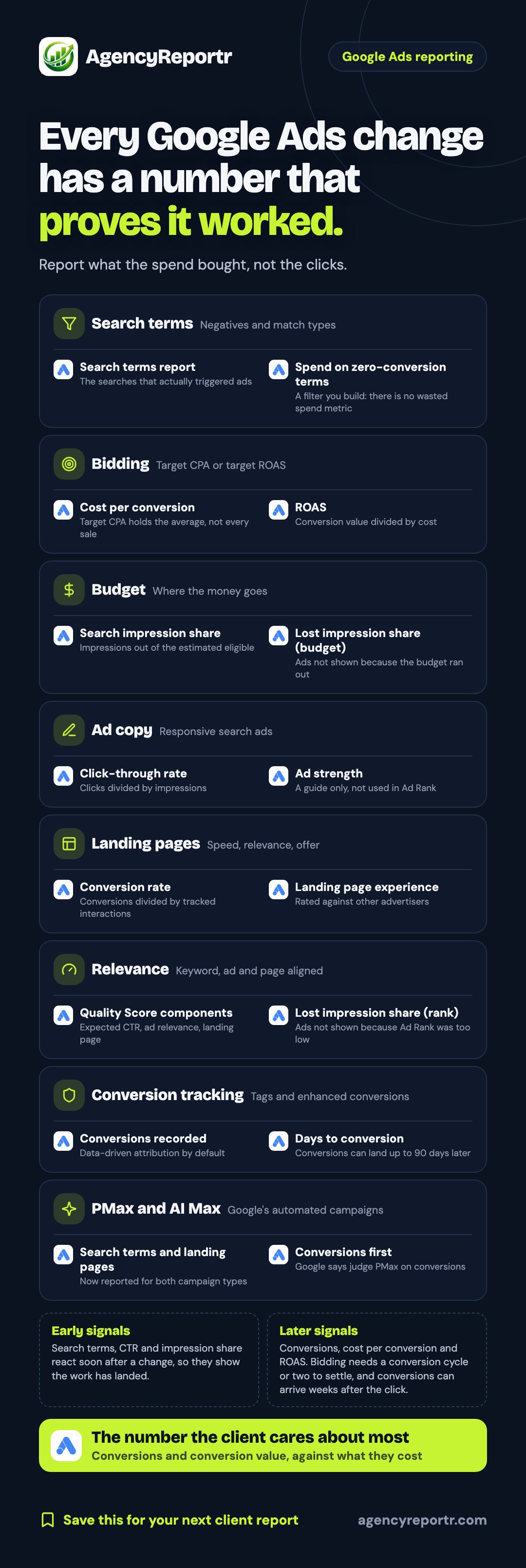
Prove each change with the one or two numbers it was meant to move, shown before and after. A change log proves the agency was busy. A matched number proves the work paid off. Here is the full map: eight kinds of account work, the proof for each, and what Google says those numbers mean.
Save it for your next client report.
Work
Proof, and what Google says it means
Negatives and match types
The search terms report shows the searches that triggered ads (some low-volume terms are omitted for privacy). Spend on terms with no conversions is a filter you build: Google has no "wasted spend" metric.
Bidding
Cost per conversion against the target, or ROAS: conversion value divided by cost.
Budget
Search impression share, an estimate, and Search lost impression share (budget), reported at campaign level only.
Ad copy
Click-through rate: clicks divided by impressions, compared with the ad's own past.
Landing pages
Conversion rate, which can exceed 100% when an account counts every conversion, and landing page experience, rated against advertisers on the exact same search over the last 90 days.
Relevance
The three Quality Score components as a diagnosis, and Search lost impression share (rank) as the outcome.
Conversion tracking
Conversions recorded, with data-driven attribution the default for most conversion actions, and enhanced conversions sending hashed first-party data, such as email addresses, to make measurement more accurate.
Performance Max and AI Max
Search terms and landing pages, now reported for both. Google says to prioritise conversion data over clicks and impressions for Performance Max.
The budget row matters more since August. A campaign that keeps its "Limited by budget" status and a high lost impression share (budget) is now the one most exposed to the bidding update, so show both numbers next to target and actual CPA. Impression share figures are updated within one to two days and are estimates, so small moves are noise. For the automated campaign types, our guide on reporting AI Max for Search covers the search terms and ad combinations view in detail.
Do Quality Score and ad strength prove anything?
No. Both are diagnostics, and Google says so. Its Quality Score page says Quality Score "is not an input in the ad auction"; it is a diagnostic tool built from expected click-through rate, ad relevance and landing page experience. Google's ad strength page says ad strength is not used to calculate Ad Rank, Quality Score or auction wins. It is a checklist for giving responsive search ads enough variety.
What does decide where ads show is Ad Rank, calculated on every search from six factors: the bid, the quality of the ads and landing page, the Ad Rank thresholds, the competitiveness of the auction, the context of the search, and the expected impact of assets and other ad formats. So report the Quality Score components to explain, and lost impression share (rank) as the result. A report that celebrates "ad strength: Excellent" is reporting effort, not results.
When should you judge a Google Ads optimization change?
Judge a bidding change after one to two conversion cycles at the earliest, and judge conversion totals only on date ranges that have finished filling in. Google says Smart Bidding typically converges on a new goal within 1 to 2 conversion cycles, and suggests evaluating over 2 conversion cycles or a 2 week window, whichever is longer. Learning status itself never lasts more than 7 days, so a strategy that has left learning can still be settling.
Conversions add a second delay. They can be reported up to 90 days after the click, depending on the conversion window, and Google recommends that a report's date range end at least 30 days ago when you need complete conversion data. Last week always looks worse than it really was.
So split the report in two. Early signals (search terms, click-through rate, impression share) react soon after a change and show the work has landed. Later signals (conversions, cost per conversion, ROAS) are the verdict. Lead with the verdict, then use the early signals to explain where it is heading. Our guide to client reports that get read covers how to order that page.
What should an agency tell the client about the August change?
Tell the client once, with dates and numbers, before they spot the higher CPA themselves. Add an annotation on 17 August 2026. For each budget-limited campaign on Target CPA or Target ROAS, show the target, the actual result in the weeks before, and the actual result since. Then say what the agency chose: keep the target, lower it, or ask for more budget, and why.
After that, the monthly report goes back to its usual shape: conversions and conversion value against cost at the top, each change paired with its proof below. A Google Ads reporting tool that pulls search terms, wasted spend, impression share and conversions on a schedule saves rebuilding it, and white label client reports keep the agency's name on every page.
Show what the spend bought
AgencyReportr builds a branded Google Ads report with search terms, wasted spend, impression share lost to budget and rank, conversions and an AI-written summary of the period. Start with a $1 trial.
Why did cost per conversion rise on a Target CPA campaign after August 2026?
If the campaign was limited by budget and beating its target, Google's 17 August 2026 bidding update makes it aim closer to the target instead. Google's example: a $10 target with a $5 actual CPA should now deliver closer to $10. Lower the target if the old cost was the one the client wants.
Did Google change my Target CPA or budget automatically?
No. Google says it won't automatically adjust bid targets or budgets. Only how a budget-limited, target-based campaign bids toward the target you already set has changed.
Does Quality Score affect where my ads show?
Not directly. Google says Quality Score is a diagnostic tool and is not an input in the ad auction. The quality of your ads and landing page does feed Ad Rank, and the three Quality Score components show where that quality is weak.
How long should I wait before judging a Google Ads optimization change?
Google says Smart Bidding typically converges within 1 to 2 conversion cycles and suggests evaluating over 2 conversion cycles or 2 weeks, whichever is longer. Conversions can be reported up to 90 days after the click, so final verdicts need a date range that ended at least 30 days ago.
Is there a wasted spend metric in Google Ads?
No. Google Ads does not report a metric called wasted spend. Agencies build it themselves, usually as cost on search terms that recorded no conversions over a period, from the search terms report.

 SEO Reporting ToolRankings, traffic & site audits
 SEO Rank Tracking ToolKeyword positions from Google
 Google Ads Reporting ToolSpend, ROAS & conversions
 Meta (FB) Ads Reporting ToolFacebook & Instagram campaigns
 LinkedIn Ads Reporting ToolLeads, cost per lead & campaigns
 Amazon Ads Reporting ToolSponsored Products, Brands & Display
 Social Media Reporting ToolInstagram, Facebook, YouTube & LinkedIn
 Google Business Profile ToolLocal visibility, reviews & calls
 YouTube Reporting ToolViews, watch time & top videos
 AI Visibility Tracking Tool NewChatGPT, Perplexity & AI Overviews
 White-Label Reporting ToolYour brand on every report
 Automated PDF ReportsScheduled delivery to every client