A year ago, most generative engine optimization reports were a screenshot of a ChatGPT answer. In 2026 three platforms started reporting AI visibility themselves. Bing Webmaster Tools added AI Performance on 10 February, GA4 added an AI Assistant channel on 13 May, and Search Console added Generative AI performance reports on 3 June, rolled out to every website on 31 August.
That changes what a GEO report can prove, but less than clients assume. Google's report counts impressions, Bing's counts citations, and neither covers ChatGPT or Perplexity. This guide sets out what each platform now reports, what it still leaves out, and the number that proves each kind of GEO work.
Key takeaways
Search Console's Generative AI reports show AI Overviews and AI Mode impressions by page, with no clicks and no queries.
Bing reports Copilot citations, and since 16 June 2026 a Citation Share per grounding query. It is not traffic.
GA4's AI Assistant channel holds ChatGPT, Gemini and Copilot visits; AI Overviews visits stay in Organic Search.
Blocking GPTBot does not remove a site from ChatGPT search. OAI-SearchBot controls that.
ChatGPT, Gemini and Perplexity answers still need a fixed prompt set, checked every month.
What do Google, Bing and GA4 now report about AI visibility?
Each platform now reports one slice of AI visibility: Google reports impressions, Bing reports citations and GA4 reports visits.
Platform
What it reports
What it does not
Search Console: Generative AI reports
Impressions in AI Overviews, AI Mode and Discover's AI features, by page, country, device and date
Clicks, queries, a split between AI Overviews and AI Mode
Bing Webmaster Tools: AI Performance
Citations in Copilot, Bing's AI summaries and select partners; grounding queries; Citation Share
Traffic share, competitor names
GA4: AI Assistant channel
Sessions and key events from recognized AI assistants
Visits from AI Overviews and AI Mode
Google's Search Central announcement defines the new metric as how often a site's URLs appeared in generative AI features in Search and Discover. Google also says this data is already included in the overall Performance report, so the new view is a slice, not an extra number to add. Bing's June update added Intents, Topics, Citation Share and Compare in preview on top of February's Total Citations and Average Cited Pages, and Bing calls its citation data a sample. GA4's release notes describe the AI Assistant channel as covering visits whose referrer matches a recognized AI assistant, with ChatGPT, Gemini and Claude as examples.
None of the three reports shows whether ChatGPT, Gemini or Perplexity names the client when a buyer asks for a recommendation. Google's report covers Google's own features, and Bing's covers Copilot, Bing and select partners. GA4 sees a visit only when someone clicks through, and only when the referrer is passed.
Google's announcement also lists pages, countries, devices and dates, not queries, so the report cannot tell you which questions the client appeared for. Bing's grounding queries and Topics help there, but only for Copilot and Bing. That is why the agency-built measures still matter: brand mention rate, cited-prompt share, share of voice and answer position across a prompt set you control.
Why does one screenshot prove nothing?
One screenshot proves nothing because AI answers are generated fresh each time, so the same question can name different businesses on different runs. The fix is to measure like a researcher: the same prompts, run the same way, on a schedule, with the share of runs that name the client tracked over time. One answer is an anecdote. Forty prompts a month for six months is a trend. Publish the prompt list with the numbers, because every agency-built metric depends on it.
Which number proves each kind of generative engine optimization work?
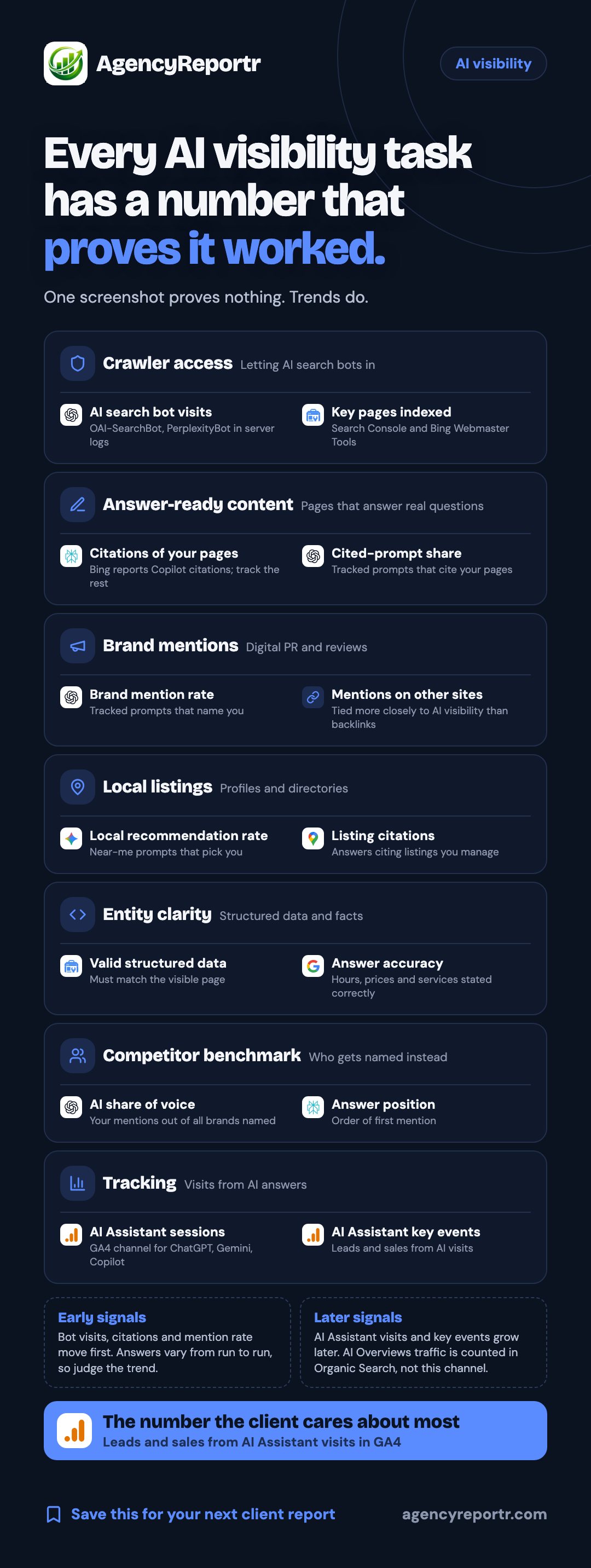
Each kind of generative engine optimization work has two numbers that show it landed: seven kinds of work, fourteen numbers, and where each comes from.
Save it for your next client report.
GEO work
Proof
Crawler access
OAI-SearchBot and PerplexityBot visits in server logs; key pages indexed in Search Console and Bing Webmaster Tools
Answer-ready content
Citations of your pages (Bing for Copilot); cited-prompt share for the rest
Brand mentions
Brand mention rate across the prompt set; mentions on other sites
Local listings
Share of "near me" prompts that pick you; answers citing listings you manage
Entity clarity
Valid structured data that matches the page; answer accuracy
Competitor benchmark
AI share of voice; order of first mention
Tracking
AI Assistant sessions and key events in GA4
How do you prove crawler access and answer-ready content?
Crawler access is proven by AI search bot visits in the server logs and key pages indexed in Search Console and Bing Webmaster Tools. Each product uses its own search crawler, separate from training. OpenAI's crawler overview says OAI-SearchBot decides whether a site can appear in ChatGPT search answers, GPTBot is for training, and each setting is independent. Perplexity says PerplexityBot surfaces and links sites in its search results and is not used to train foundation models. Google says Google-Extended does not affect inclusion or ranking in Google Search. A client can opt out of training without leaving AI search.
Content work, pages that answer the questions customers actually ask, is proven by citations: how often the client's own pages are shown as a source. Bing now counts this for Copilot. For ChatGPT, Gemini and Perplexity, track cited-prompt share, the share of your prompts where a client URL is cited. For Google, the new report shows which pages earn AI impressions, and Google's guidance says there are no additional requirements to appear in AI Overviews or AI Mode beyond being indexed and eligible for a snippet.
How do you prove brand mention, listing and entity work?
Brand mention work is proven by mention rate across the prompt set, with mentions on other sites as the input you can count. In Ahrefs' study of 75,000 brands, branded web mentions correlated with appearing in Google's AI Overviews at 0.664, against 0.218 for backlinks. It is a correlation and covers AI Overviews only, but it ties AI visibility more closely to being talked about than to being linked to.
Listing work is proven by the share of "near me" prompts that recommend the client and by how many answers cite listings the client manages. Entity work, making sure AI systems state the right services, prices, hours and locations, is proven by answer accuracy: the share of brand answers that get the facts right. Report valid structured data in Search Console as hygiene, and note that Google says structured data should match the visible text on the page.
How do you benchmark competitors in AI answers?
Competitors are benchmarked with AI share of voice, the client's mentions out of all brands named across the prompt set, and answer position, the order of first mention. Bing's Citation Share is the closest platform-reported version: the percentage of citations attributed to your site out of all citations for a grounding query. Bing says it does not expose competitor domains or represent traffic share, so it tells a client how much of Copilot's sourcing they hold, not who holds the rest. Keep your own prompt set stable, or the competitor trend means nothing.
Where do AI visits and leads show up in GA4?
AI visits show up in GA4's AI Assistant channel, which Google's channel definitions say covers sources like ChatGPT, Gemini, Deepseek, Copilot and Grok. Add key events and generative engine optimization finally shows enquiries and sales. One gap to explain: visits from Google's AI Overviews and AI Mode stay in Organic Search, not this channel. Our guide to AI referral traffic in GA4 covers the setup, and SEO KPIs for each task shows where these AI numbers sit next to classic SEO proof.
Put leads and sales from AI Assistant visits first, then the early signals underneath: bot visits, citations and mention rate move first, while visits and key events grow later. A client who wants out of Google's AI answers entirely has a separate choice, covered in our post on the AI Overviews opt-out. For the rest, AI visibility tracking runs the same prompts across ChatGPT, Gemini, Perplexity and Google AI Overviews every month, inside the same SEO reporting tool as Search Console and GA4.
Replace screenshots with a trend
AgencyReportr tracks brand mentions, answer position and cited pages across ChatGPT, Gemini, Perplexity and Google AI Overviews, next to AI assistant traffic from GA4, in one white-label SEO report. Start with a $1 trial.
How do you measure generative engine optimization?
Combine the platform reports with a prompt set you run yourself. Use Search Console's Generative AI report for Google AI impressions, Bing Webmaster Tools for Copilot citations, and GA4's AI Assistant channel for visits and key events. Then run the same prompts every month in ChatGPT, Gemini, Perplexity and Google AI Overviews and record whether the brand is named and which pages are cited.
Does Search Console show clicks from AI Overviews separately?
No. Google's Generative AI performance reports, launched on 3 June 2026 and rolled out to all websites on 31 August 2026, list impressions only. Clicks from AI Overviews and AI Mode are counted inside the regular Performance report under the Web search type, mixed with other clicks.
Does blocking GPTBot remove a site from ChatGPT?
No. OpenAI sets its crawlers independently. GPTBot is for model training; OAI-SearchBot decides whether a site can appear in ChatGPT search answers. A site can block GPTBot and still allow OAI-SearchBot.
What is Citation Share in Bing Webmaster Tools?
Bing defines it as the percentage of citations attributed to your site out of all citations shown across all sites for a grounding query. It was added in preview on 16 June 2026. Bing says it does not expose competitor domains or represent traffic share.
Where does AI traffic show up in GA4?
Visits from assistants such as ChatGPT, Gemini, Deepseek, Copilot and Grok are grouped in the AI Assistant default channel, added on 13 May 2026. Visits from Google's AI Overviews and AI Mode are not; they stay in Organic Search.

 SEO Reporting ToolRankings, traffic & site audits
 SEO Rank Tracking ToolKeyword positions from Google
 Google Ads Reporting ToolSpend, ROAS & conversions
 Meta (FB) Ads Reporting ToolFacebook & Instagram campaigns
 LinkedIn Ads Reporting ToolLeads, cost per lead & campaigns
 Amazon Ads Reporting ToolSponsored Products, Brands & Display
 Social Media Reporting ToolInstagram, Facebook, YouTube & LinkedIn
 Google Business Profile ToolLocal visibility, reviews & calls
 YouTube Reporting ToolViews, watch time & top videos
 AI Visibility Tracking Tool NewChatGPT, Perplexity & AI Overviews
 White-Label Reporting ToolYour brand on every report
 Automated PDF ReportsScheduled delivery to every client