Google gave agencies two new AI numbers this year. GA4 added an AI Assistant channel on 13 May 2026, and Search Console added Generative AI performance reports on 3 June 2026, rolled out to every website on 31 August. Clients have started to see both, and the first question is usually whether they are the result. They are not. They are two more numbers to place correctly, next to the ones that prove the work was worth paying for.
Clients do not pay for SEO tasks. They pay for what the tasks did. This guide pairs each kind of SEO work with the KPI that should move if it worked, says where Google reports it, and marks where this year's changes moved the numbers underneath.
Key takeaways
Report the proof, not the task list: each kind of SEO work has a number that should move if it worked.
GA4's AI Assistant channel counts visits from assistants such as ChatGPT, Gemini and Claude. AI Overviews and AI Mode stay in Organic Search.
Search Console's Generative AI reports show impressions only, and those impressions are already inside the main Performance report.
Impressions from 13 May 2025 to 27 April 2026 were misreported, and FAQ rich results stopped showing from 7 May 2026.
Lead with leads and sales from Organic Search as key events in GA4, then show the early signals that explain them.
What changed in Google's SEO numbers this year?
Four changes in 2026 touch the numbers an SEO report is built on: two add AI numbers, and two change old ones. None of them changes what the client is paying for.
GA4 has an AI Assistant channel. Google's Analytics release notes dated 13 May 2026 describe a new AI Assistant channel in Default Channel Group reports. When the referrer matches a recognized AI assistant, GA4 sets the medium to "ai-assistant" and the campaign to "(ai-assistant)". The note names ChatGPT, Gemini and Claude as examples, and Google's channel definitions add Deepseek, Copilot and Grok. Google's AI Overviews and AI Mode are excluded and count in Organic Search. The note does not say whether visits from before 13 May were moved into the new channel.
Search Console counts AI impressions. Google's Search Central announcement of 3 June 2026 introduced Search Generative AI performance reports: how often URLs from a site appeared in generative AI features in Search and Discover, by page, country, device (Search only) and date. They began with a subset of sites and reached all websites worldwide as of 31 August 2026. Google says this data "is included in the overall performance report". The announcement lists impressions only. It does not mention clicks, and it does not split AI Overviews from AI Mode.
Two old numbers moved. Search Console's data anomalies page says a logging error kept impressions from being reported accurately from 13 May 2025 until 27 April 2026; clicks were not affected. And Google's FAQ documentation says FAQ rich results no longer appear in Google Search, starting 7 May 2026.
Which SEO KPIs prove each kind of SEO work?
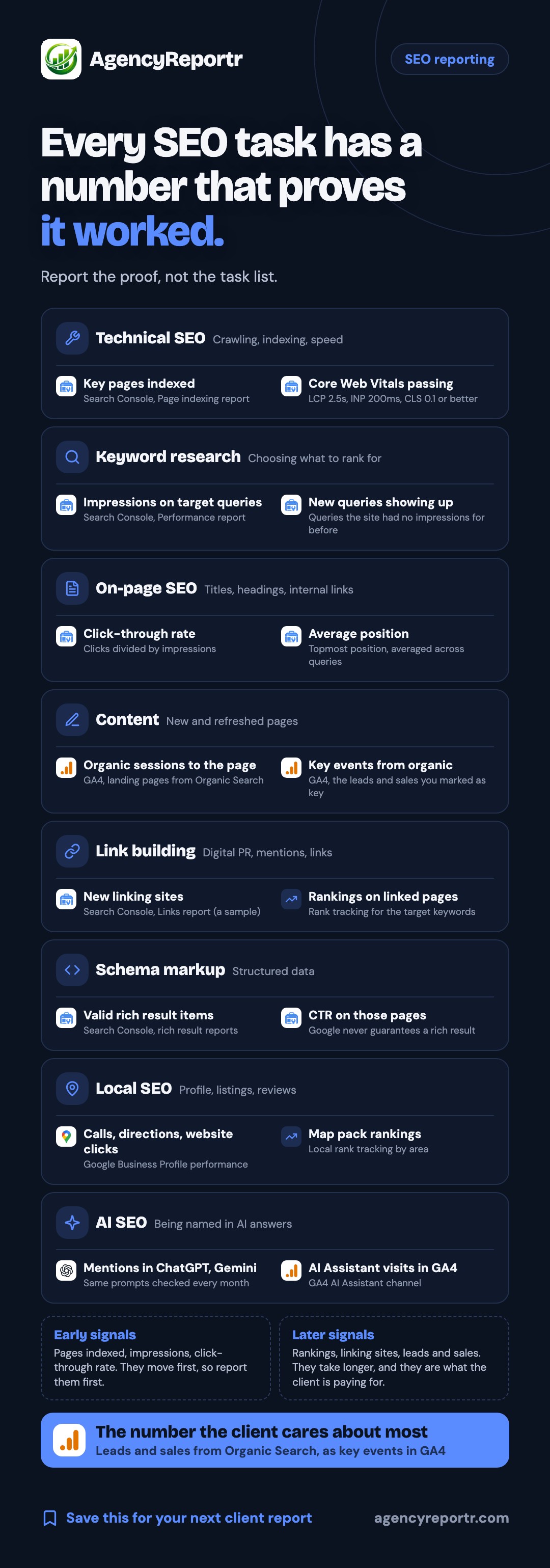
Each kind of SEO work has two numbers that show it worked, and almost all of them live in Google's own tools: Search Console, GA4 and Google Business Profile.
Save it, or share it with a client who asks what SEO is for.
SEO work
KPI that proves it
Where it lives
Technical SEO
Key pages indexed, Core Web Vitals passing
Search Console: Page indexing, Core Web Vitals
Keyword research
Impressions on target queries, new queries
Search Console: Performance
On-page SEO
Click-through rate, average position
Search Console: Performance
Content
Organic sessions to the page, key events
GA4: Organic Search by landing page
Link building
New linking sites, rankings on linked pages
Search Console: Links; rank tracking
Schema markup
Valid rich result items, CTR on those pages
Search Console: rich result reports
Local SEO
Calls, directions, website clicks; map pack rankings by area
Google Business Profile; local rank tracking
AI SEO
Mentions in ChatGPT and Gemini, AI Assistant visits
Same prompts checked monthly; GA4
Technical SEO KPIs: are the key pages indexed and fast?
The first technical KPI is whether the pages that matter are indexed, read from the Page indexing report in Search Console. Do not report the total. Google's help page says not to expect every URL on a site to be indexed, because some are duplicates or have little content. Report the service pages, top products and new articles instead. "Discovered, currently not indexed" means Google found a page but has not crawled it yet; "Crawled, currently not indexed" means it crawled the page and left it out for now.
The second is page experience. The Core Web Vitals thresholds for a good result are Largest Contentful Paint within 2.5 seconds, Interaction to Next Paint of 200 milliseconds or less, and Cumulative Layout Shift of 0.1 or less, measured at the 75th percentile of page loads. "Share of key URLs passing" is a number a client can follow month to month.
Keywords and on-page: impressions, CTR and average position
Keyword research is proven by impressions on the target queries, and on-page work by click-through rate and average position, all in the Search Console Performance report. A good early sign is new queries appearing that the site never had impressions for.
Google's Performance report metrics page defines an impression as a user having seen, or potentially seen, a link to the site. Click-through rate is clicks divided by impressions, the cleanest test of a rewritten title. Average position uses the topmost position the site held for each query, averaged across queries, and every link inside an AI Overview gets that same position. Explain this once, or a client will read a jump in average position as "we are now in the top three".
Two cautions belong in any year-over-year view. Impressions, CTR and average position before 27 April 2026 sit inside the logging error, so last year's baseline is not like for like; our post on the Search Console impressions correction covers how to annotate it. And since the Generative AI impressions are already in the overall report, never add them to the Search Console total. Show them as a share of it.
Content KPIs: organic sessions and key events
Content is proven by organic sessions to the pages you created or refreshed, from the Organic Search channel by landing page in GA4, and by the key events those visits produce. Key events are what GA4 used to call conversions. Mark the enquiry form, the booking, the call click or the purchase as key events, and organic content connects to money.
The AI Assistant channel matters here because it changes where some visits land. Visits from ChatGPT or Gemini now appear as their own channel rather than mixed into other rows, while a visit that came through an AI Overview still counts as Organic Search. If a client compares channels across 13 May 2026, check whether their Referral or AI Assistant rows shifted on that date before calling it a trend.
Links and schema KPIs after FAQ rich results ended
Link building is proven by new linking sites in the Search Console Links report and by the rankings of the pages those links point to. Google says the Links report shows a sample, not every link, so say that in the report. If the linked pages are not moving in keyword rank tracking, the links are not doing much.
Schema is proven by valid rich result items and the click-through rate of those pages. Google's structured data guidelines say it does not guarantee structured data will show in results, so never promise stars or extra lines. The FAQ change shows why: FAQ markup can still be valid, but FAQ rich results stopped appearing from 7 May 2026, so FAQ impressions fell for reasons that had nothing to do with rankings. Drop FAQ results from the schema KPI and report the rich result types Google still shows.
Local and AI SEO KPIs: proof outside the website
For local work, the proof is calls, direction requests and website clicks from the Google Business Profile, plus map pack rankings checked by area. Google defines calls as clicks on the call button in the profile, so manual dials are not counted. Our guide to Google Business Profile insights covers which of these to lead with.
For AI search, there are now two Google numbers and one check of your own. Search Console's Generative AI report shows whether pages appear in AI Overviews and AI Mode. GA4's AI Assistant channel shows whether ChatGPT, Gemini and others send visits that convert. Neither shows whether an assistant names the client when a buyer asks for a recommendation. That needs the same customer prompts checked every month in ChatGPT, Gemini and Perplexity, recorded as mentions. Our post on why ChatGPT recommends competitors covers what drives those mentions, and AI visibility tracking runs the monthly check.
In what order should SEO KPIs go in a client report?
SEO KPIs go in the order the client values them: leads and sales from Organic Search first, then the early signals that explain them, then the task-by-task proof. Pages getting indexed, impressions and click-through rate move first. Rankings, linking sites, leads and sales take longer, and they are what the client is paying for. A report that shows only the late numbers looks like failure in the first months; one that shows only the early numbers looks like activity without results.
Agree the KPIs before the work starts. Google's own advice to businesses hiring an SEO is to ask what results to expect, in what timeframe and how success will be measured. If the client was told to ask, the report should answer, in the same layout every month. Our SEO report template lays out those sections, and an SEO reporting tool that pulls Search Console, GA4 key events, AI Assistant visits and rank tracking into one report saves rebuilding it by hand.
Show the proof, not the task list
AgencyReportr puts Search Console, GA4 key events, AI assistant traffic, rank tracking, a site audit and AI visibility in one branded SEO report, with an AI-written summary at the top. Start with a $1 trial.
Leads and sales from Organic Search, tracked as key events in Google Analytics 4. Under them, report the numbers that show each piece of work paid off: key pages indexed, impressions and click-through rate in Search Console, organic sessions to the pages you worked on, new linking sites and rankings for the target keywords.
Is the GA4 AI Assistant channel an SEO KPI?
It is a useful one for AI search work. Since 13 May 2026, GA4 groups visits from recognized AI assistants such as ChatGPT, Gemini and Claude into an AI Assistant channel. Report its sessions and key events. Visits from Google's AI Overviews and AI Mode are not in it; they stay in Organic Search.
Should I add Generative AI impressions to Search Console impressions?
No. Google says the data in the Search Generative AI performance reports is included in the overall performance report. Adding the two together counts the same impressions twice. Show the AI figure as a share of the total instead.
Should every page on the site be indexed?
No. Google's Page indexing report help says not to expect every URL to be indexed, because some are duplicates or have little content. Track whether the pages that matter to the business are indexed rather than the total count.
How soon should SEO KPIs move?
Early signals such as pages indexed, impressions and click-through rate move first. Rankings, linking sites, leads and sales take longer. Google suggests businesses ask an SEO what results to expect, in what timeframe and how success is measured, so agree the KPIs and the timeframe before the work starts.

 SEO Reporting ToolRankings, traffic & site audits
 SEO Rank Tracking ToolKeyword positions from Google
 Google Ads Reporting ToolSpend, ROAS & conversions
 Meta (FB) Ads Reporting ToolFacebook & Instagram campaigns
 Amazon Ads Reporting ToolSponsored Products, Brands & Display
 Social Media Reporting ToolInstagram, Facebook, YouTube & LinkedIn
 Google Business Profile ToolLocal visibility, reviews & calls
 YouTube Reporting ToolViews, watch time & top videos
 AI Visibility Tracking Tool NewChatGPT, Perplexity & AI Overviews
 White-Label Reporting ToolYour brand on every report
 Automated PDF ReportsScheduled delivery to every client